Why Your Sunscreen Isn’t Working: 10 Common Mistakes That Reduce Protection
Sunscreen is one of the most important skincare products for preventing sunburn, premature aging, dark spots, and skin cancer. Yet many people still experience tanning, pigmentation, or sunburn even after applying sunscreen every day.
The reason is often not the sunscreen itself—it’s how it’s being used.
In this comprehensive guide, you’ll learn why your sunscreen may not be working, the most common mistakes people make, and how to get the maximum protection from your SPF.
What Does Sunscreen Actually Do?
Sunscreen protects your skin from the sun’s harmful ultraviolet (UV) rays.
There are two main types of UV radiation:
UVA Rays
- Cause premature aging
- Lead to wrinkles and fine lines
- Trigger pigmentation and melasma
- Penetrate glass
UVB Rays
- Cause sunburn
- Damage skin cells
- Increase the risk of skin cancer
A broad-spectrum sunscreen protects against both UVA and UVB rays.
Signs Your Sunscreen Isn’t Working
If you notice these issues despite wearing sunscreen, you may be using it incorrectly.
- Skin tanning quickly
- Frequent sunburn
- New dark spots
- Melasma worsening
- Redness after outdoor activities
- Uneven pigmentation
- Faster skin aging
- Dry, irritated skin after sun exposure
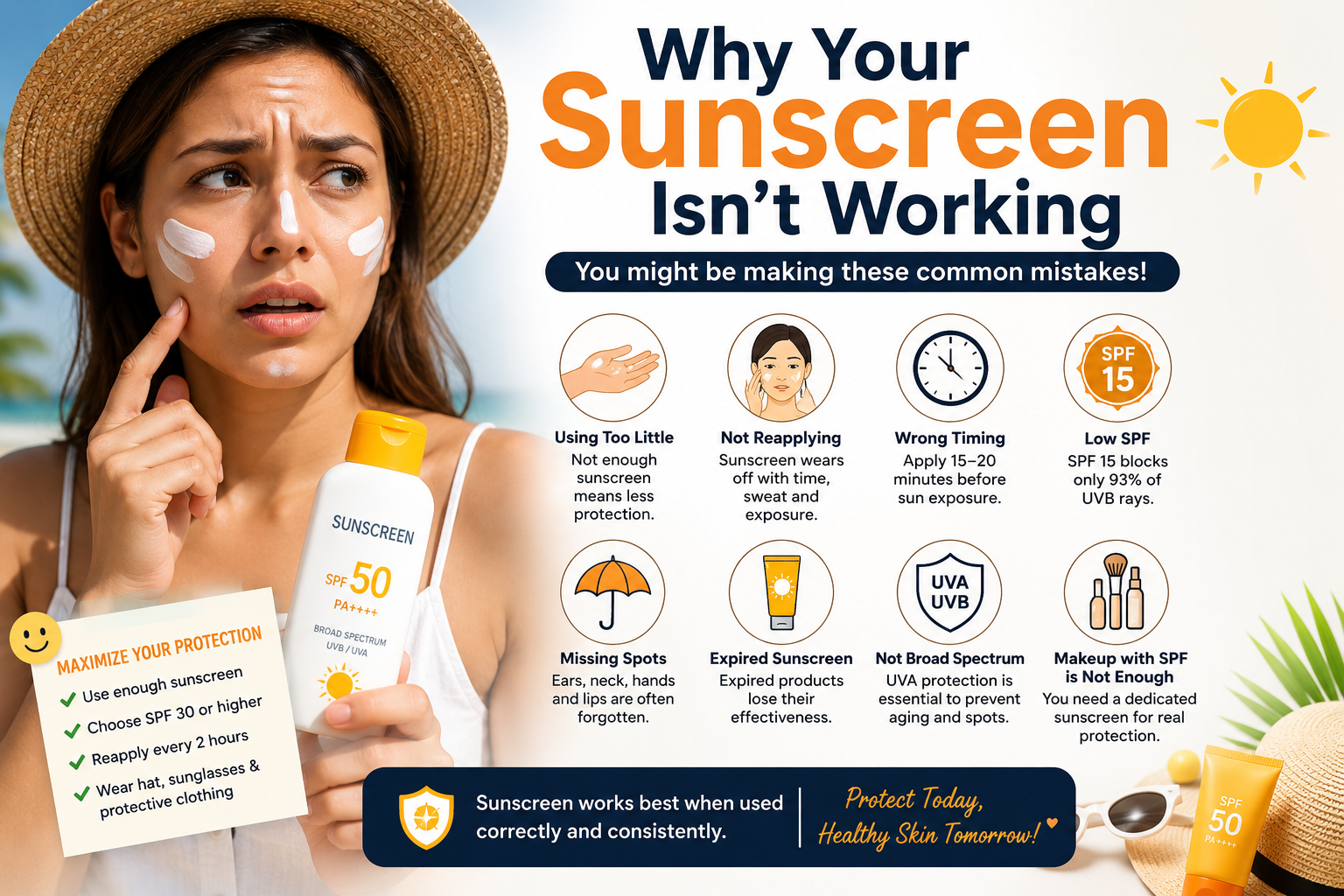
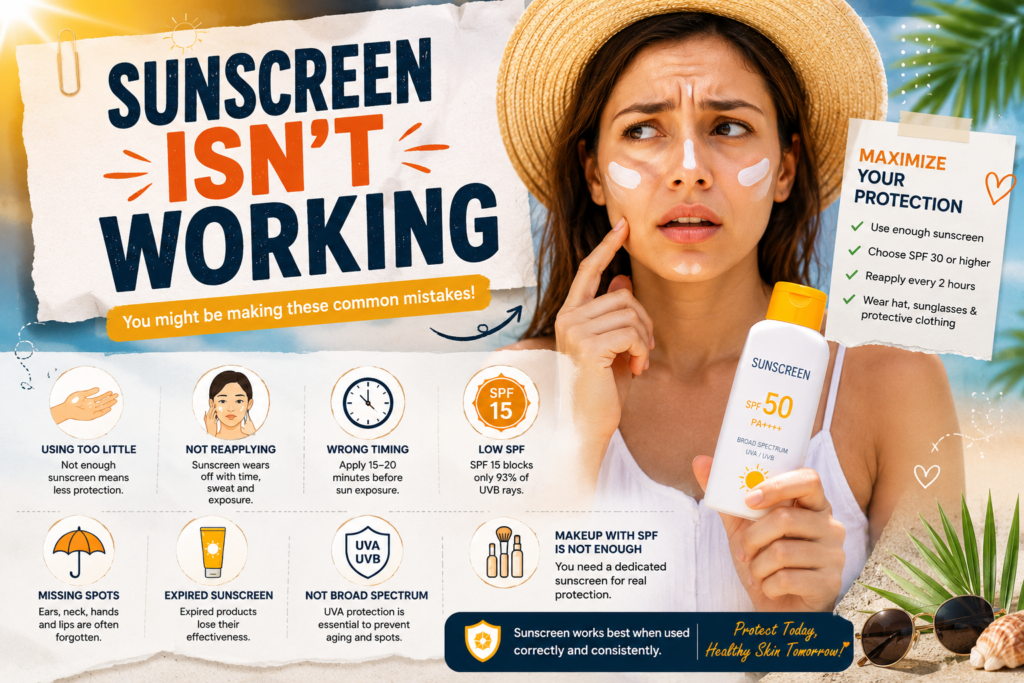
1. You’re Not Applying Enough Sunscreen
This is the biggest mistake.
Most people apply only 25–50% of the amount needed.
Correct Amount
For the face:
- Two-finger rule (index and middle finger)
For face + neck:
- Approximately 1/3 teaspoon
For the body:
- About one shot glass (30 ml)
Using less sunscreen dramatically reduces the actual SPF protection.
Example:
- SPF 50 applied too thinly may provide protection closer to SPF 20 or lower.
2. You’re Not Reapplying
Sunscreen doesn’t last all day.
It gradually breaks down due to:
- Sweat
- Oil
- Water
- Friction
- UV exposure
Reapply Every:
- Every 2 hours outdoors
- Immediately after swimming
- After heavy sweating
- After towel drying
3. You’re Applying Sunscreen Too Late
Chemical sunscreens need time to absorb.
Apply:
- 15–20 minutes before sun exposure
Mineral sunscreens work immediately but still benefit from even application before going outside.
4. You’re Using the Wrong SPF
Many people think SPF 15 is enough for everyone.
SPF Comparison
| SPF | UVB Protection |
|---|---|
| SPF 15 | 93% |
| SPF 30 | 97% |
| SPF 50 | 98% |
| SPF 100 | 99% |
Dermatologists generally recommend SPF 30 or higher for everyday use and SPF 50 for prolonged outdoor exposure.
5. You’re Skipping Certain Areas
These spots are commonly forgotten:
- Ears
- Neck
- Hairline
- Eyelids
- Lips
- Nose
- Back of hands
- Feet
- Scalp (for thinning hair)
These areas frequently develop sun damage.
6. Your Sunscreen Has Expired
Expired sunscreen becomes less effective.
Signs include:
- Strange smell
- Separation
- Color changes
- Grainy texture
- Watery consistency
Most sunscreens remain effective for about three years if stored properly, but always check the expiration date.
7. You’re Not Using Broad-Spectrum Sunscreen
Some products mainly protect against UVB rays.
Without UVA protection, your skin can still experience:
- Wrinkles
- Pigmentation
- Collagen breakdown
- Skin aging
Always choose products labeled:
- Broad Spectrum
- PA+++
- PA++++
Higher PA ratings generally indicate stronger UVA protection.
8. You’re Relying Only on Makeup with SPF
Foundation, BB cream, or powder with SPF is helpful but not enough.
To achieve the labeled SPF, you’d need to apply far more makeup than most people use.
Use makeup SPF as an extra layer—not your primary sun protection.
9. You’re Not Wearing Sunscreen Indoors
UVA rays can penetrate windows.
If you:
- Work near windows
- Drive frequently
- Spend time in bright rooms
Daily sunscreen can still help reduce cumulative UVA exposure.
10. You’re Not Pairing Sunscreen with Other Sun Protection
Sunscreen works best as part of a complete sun-protection routine.
Also use:
- Sunglasses with UV protection
- Wide-brimmed hats
- UV-protective clothing
- Umbrellas
- Shade during peak sunlight hours (10 AM–4 PM)
Choosing the Right Sunscreen for Your Skin Type
Oily Skin
Look for:
- Gel sunscreen
- Matte finish
- Oil-free
- Non-comedogenic
Dry Skin
Choose:
- Cream sunscreen
- Hyaluronic acid
- Ceramides
- Glycerin
Sensitive Skin
Best ingredients:
- Zinc Oxide
- Titanium Dioxide
- Fragrance-free formulas
- Alcohol-free formulas
Acne-Prone Skin
Choose:
- Lightweight gel
- Oil-free
- Non-comedogenic
- Niacinamide-containing formulas
Physical vs Chemical Sunscreen
Mineral (Physical) |
Chemical |
|---|---|
Zinc Oxide |
Avobenzone |
Titanium Dioxide |
Octinoxate |
Works immediately |
Needs 15–20 minutes |
Better for sensitive skin |
Lightweight feel |
Less irritation |
Often leaves no white cast |
May leave white cast |
Comfortable for daily wear |
Ingredients to Look For
Effective UV filters include:
Mineral Filters
-
Zinc Oxide
-
Titanium Dioxide
Chemical Filters
-
Avobenzone
-
Uvinul A Plus
-
Uvinul T150
-
Tinosorb S
-
Tinosorb M
-
Mexoryl SX
-
Mexoryl XL
Daily Sunscreen Routine
Morning
-
Cleanser
-
Moisturizer (if needed)
-
Sunscreen (SPF 30–50+, broad-spectrum)
-
Makeup (optional)
During the Day
-
Reapply every 2 hours outdoors.
-
Reapply after swimming, sweating, or towel drying.
Evening
-
Remove sunscreen thoroughly with a cleanser (double cleansing can help if you wear water-resistant sunscreen or makeup).
-
Continue with your nighttime skincare routine.
Who Should Wear Sunscreen Every Day?
Daily sunscreen is recommended for:
-
Children older than 6 months (use age-appropriate products and follow pediatric guidance)
-
Teenagers
-
Adults
-
Older adults
-
People with acne
-
People with melasma
-
Individuals using retinoids or exfoliating acids
-
People with sensitive skin
-
Outdoor workers
-
Office workers who sit near windows or drive frequently
Can Sunscreen Prevent Tanning?
Sunscreen significantly reduces tanning but cannot block 100% of UV radiation. Proper application, adequate quantity, timely reapplication, and combining sunscreen with protective clothing and shade provide the best defense.
Expert Tips for Maximum Protection
- Choose a broad-spectrum SPF 30 or SPF 50+ sunscreen.
- Apply generously using the two-finger rule for your face.
- Cover often-missed areas like the ears, neck, and hands.
- Apply 15–20 minutes before sun exposure if using a chemical sunscreen.
- Reapply every two hours when outdoors.
- Wear hats, sunglasses, and UV-protective clothing.
- Replace expired sunscreen and store it away from excessive heat.